Fuel Price Hedging: How companies can protect their margins from market volatility?
For companies that consume large volumes of fuel, diesel and petrol are not simply ordinary operating expenses. They can represent a significant share of production, transportation, or service delivery costs.
2026 is a particularly striking example. The crisis in the Middle East has led to sharp fluctuations in crude oil prices and, even more significantly, in the prices of certain refined products.
For companies exposed to this type of risk, the key question is therefore no longer simply which direction fuel prices will move, but above all: how can the impact of this uncertainty on the company’s margins and budgets be reduced?
The oil market has changed dramatically since the beginning of the year
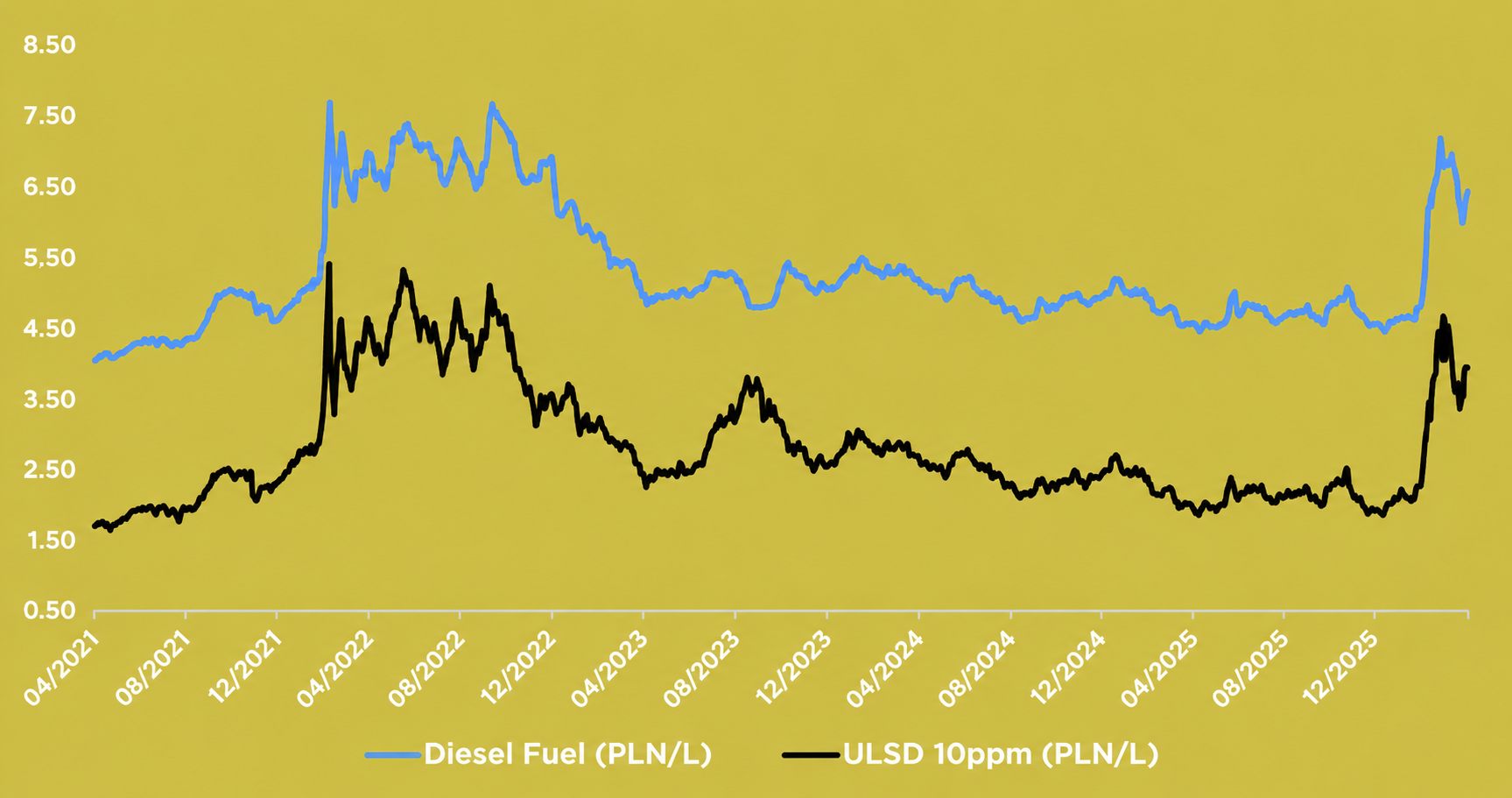
At the beginning of 2026, the oil market was still operating in a relatively moderate price environment. By the end of January, Brent crude was trading at around USD 64–65 per barrel. In Poland, the average price of a litre of Pb95 petrol was approximately PLN 5.64, while diesel stood at around PLN 5.98 per litre.
The situation changed dramatically with the escalation of the conflict in the Middle East and disruptions to oil and petroleum product flows in the region.
The Strait of Hormuz is one of the world’s most important oil transportation routes. Under normal conditions, nearly 20 million barrels of crude oil and petroleum products pass through the strait every day.
The market reaction was immediate: a sharp rise in crude oil prices, concerns over refining capacity, and particularly strong increases in the prices of certain refined products.
For a company consuming fuel, one point is essential to understand: the price of crude oil is not always the best indicator of a company’s actual fuel price risk.
Diesel prices can rise faster than Brent due to specific issues affecting refineries, inventory levels, or the availability of refined products. This means that even if crude oil prices begin to stabilise, diesel or petrol prices may remain high.
In Poland, the increase in prices was further amplified by changes to the tax system and support mechanisms. At the beginning of September, the national average stood at approximately PLN 7.63/l for Pb95 petrol and PLN 8.39/l for diesel, representing an increase of around 35% for petrol and 40% for diesel compared with January levels.
For an individual, this simply means paying more at the pump. For a company consuming several million litres of fuel per year, it can have a significant impact on operating profit.
Which companies are exposed to rising fuel prices?
The risk primarily affects companies in the road transport and logistics sector, but in reality, the exposure is much broader.
It includes, among others:
- freight transport companies;
- courier and delivery companies;
- passenger transport operators;
- construction and infrastructure companies;
- agricultural businesses;
- waste collection and processing companies;
- machinery and vehicle rental companies;
- certain industrial companies;
- any company operating a large fleet of vehicles or fuel-consuming equipment.
Exposure becomes particularly significant when three factors occur simultaneously: high consumption volumes, relatively low margins, and limited ability to quickly pass higher fuel costs on to customers.
A company consuming 5 million litres of diesel per year, all other factors remaining unchanged, would incur PLN 2.5 million in additional costs if its average fuel price increased by just PLN 0.50 per litre.
With an increase of PLN 1 per litre, the impact would rise to PLN 5 million per year.
From a CFO’s perspective, the issue is therefore not simply the absolute level of fuel prices. What matters even more is their unpredictability.
What determines fuel prices in Poland?
The price paid at a Polish petrol station primarily depends on four main components.
International prices of crude oil and refined products
Crude oil prices are obviously important. However, from the end consumer’s perspective, the price of refined diesel or petrol is even more relevant.
USD/PLN exchange rate
International crude oil and refined product markets are predominantly quoted in US dollars.
A Polish company can therefore simultaneously experience:
- an increase in the international price of diesel;
- an appreciation of the US dollar against the Polish zloty.
These two effects can compound one another. Conversely, a stronger zloty can partially offset an increase in fuel market prices.
Taxes and mandatory charges
Excise duty, VAT, fuel charges, and other mandatory levies represent a significant share of the final price paid at the pump.
Domestic costs and margins
Logistics costs, distributor margins, and the level of competition in the domestic market also affect the final price.
The mechanism can therefore be simplified as follows:
International refined product price + USD/PLN + taxes and charges + distribution costs and margins = price paid at the pump.
Price structure: Pb95 petrol and diesel
A fundamental distinction needs to be made between the total price paid at the pump and the portion of that price that can be hedged on financial markets.
As an indication, the price structure can be represented as follows:
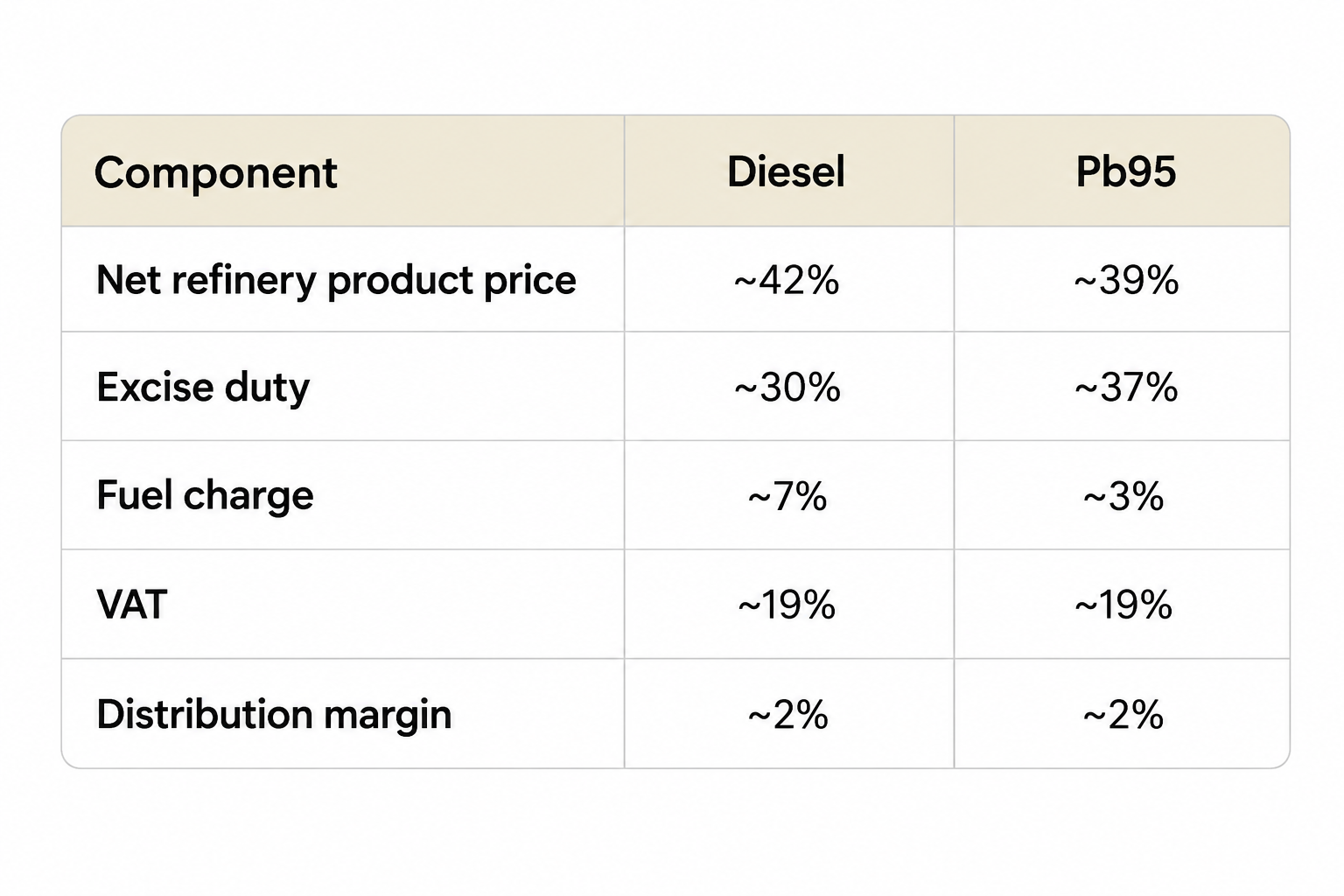
These proportions are not fixed and change depending on market price levels and changes in taxation.
However, this distinction is crucial: financial hedging does not necessarily mean fixing the entire price paid at the pump.
It primarily makes it possible to reduce the volatility of the portion of the cost that is directly linked to the international market.
Taxes, regulatory changes, distribution margins, and differences between the price invoiced by the supplier and the international index remain variable components.
Which benchmarks should be used for Pb95 petrol and diesel?
For a hedge to be effective, the benchmark used should be as closely aligned as possible with the price actually paid by the company.
It may seem that the simplest solution would be to hedge Brent directly, since diesel is produced from crude oil.
However, this approach may not be optimal.
Diesel prices depend not only on crude oil prices, but also on refining costs, the availability of refined products, and specific conditions in the European market.
For Pb95 petrol in Europe, one of the main benchmarks is:
Platts Premium Unleaded 10 ppm CIF Northwest Europe.
For diesel:
Platts ULSD 10 ppm CIF Northwest Europe.
ULSD stands for Ultra-Low Sulphur Diesel.
These benchmarks reflect refined product prices in the Northwest European market and have historically shown a high correlation with net prices observed in Poland.
Why is correlation so important?
A hedge is effective only if the benchmark used behaves similarly to the actual physical fuel price paid by the company.
If the price of diesel purchased by the company rises by 20%, while the benchmark used for hedging rises by only 5%, the level of protection will be insufficient.
The principle is therefore simple:
We do not hedge crude oil simply because a company consumes fuel. We hedge the benchmark that best explains movements in the price actually paid by the company.
For a Polish company consuming diesel, this means using ULSD 10 ppm CIF Northwest Europe, potentially converted into PLN.
Why hedge fuel prices?
The purpose of financial hedging is not to predict the market or systematically seek the lowest possible purchase price.
The objective is to transform a volatile and unpredictable cost into a manageable one.
Protecting the company against price increases
Hedging reduces the financial impact of a sharp increase in fuel prices.
Greater budget predictability
A company can determine a significant portion of its energy costs several months in advance, making it easier to:
- prepare budgets;
- calculate production costs;
- plan cash flows;
- negotiate commercial contracts.
Protecting margins
If a company signs a fixed-price contract with a customer for six, twelve, or eighteen months, its revenue is largely secured.
Its fuel costs, however, may not be.
A sharp increase in diesel prices can therefore directly reduce the margin generated by the contract.
Reducing volatility in financial performance
For a company consuming several million litres of fuel per year, a change of just a few dozen groszy per litre can result in a difference of several million PLN in annual financial performance.
From a CFO’s perspective, the key question therefore becomes:
If my business is profitable at a given diesel price level, why should I leave that margin entirely exposed to future market movements?
Hedging structure: how a swap works
One of the simplest instruments used to hedge fuel prices is a commodity swap.
The mechanism is straightforward: the financial hedge does not change the way the company physically purchases its fuel.
The company continues to buy diesel from its existing suppliers.
At the same time, it enters into a financial contract specifying:
- the benchmark;
- the volume;
- the period;
- the fixed price.
Suppose a company wants to hedge:
- 4.5 million litres;
- over a period of 18 months;
- using ULSD 10 ppm CIF Northwest Europe as the benchmark;
- at a hedge price of PLN 2.79/litre for the hedged portion of the cost.
Each month, the average of the daily ULSD quotations is calculated.
If the market is above PLN 2.79/litre
Suppose the average price for a given month is PLN 3.20/litre.
The company receives:
3.20 – 2.79 = PLN 0.41 for each hedged litre.
The financial payment offsets the increase in the cost of physical fuel.
If the market is below PLN 2.79/litre
Suppose the market price falls to PLN 2.40/litre.
The company pays:
2.79 – 2.40 = PLN 0.39 for each hedged litre.
At the same time, it benefits from the lower physical fuel price.
The intended economic outcome is therefore that the hedged portion of the cost remains close to the price fixed in the swap, regardless of the direction of market movements.
A standard swap and the forward curve: can a company hedge below the spot price?
This is one of the most interesting aspects of commodity markets.
The price fixed today for future months does not necessarily have to be equal to the current spot price.
The market has a forward curve, which represents prices for different future delivery periods.
If the curve is in backwardation, meaning forward prices are lower than the spot price, a company can hedge future months of consumption at a price below the level currently observed in the market.
For example, suppose ULSD is currently trading at approximately PLN 4.00/litre, while average prices available for the following 18 months make it possible to structure a swap at around PLN 2.79/litre.
The company can then financially hedge part of its future consumption at approximately PLN 2.79/litre without having to wait for the current spot price to actually fall to that level.
A swap is not structured solely on the basis of the current spot price. Its pricing is based on forward prices corresponding to the individual periods covered by the hedge.
This is particularly important for a company that has just experienced a sharp increase in fuel prices:
Implementing a hedge after a sharp market increase does not necessarily mean locking in today’s high spot price.
Fuel price hedging is a risk management decision, not a bet on market direction
The events of 2026 clearly demonstrate how difficult it is to predict energy markets.
Within just a few months, a geopolitical crisis can simultaneously affect:
- crude oil prices;
- the availability of refining capacity;
- diesel and petrol prices;
- supply routes;
- exchange rates;
- and, consequently, the price paid by companies.
For a company consuming large volumes of fuel, simply waiting for prices to fall therefore means remaining significantly exposed to market risk.
A hedging strategy begins with four simple questions:
How many litres of fuel does the company consume?
At what rate is the fuel consumed?
How does the supplier determine the fuel price?
Which market benchmark best explains movements in that price?
Only then can the company determine what proportion of consumption should be hedged, for which periods, and using which instruments.
The objective is not to predict the next move in oil prices.
It is about replacing the difficult question:
“How much will fuel cost in six months?”
with a much more useful one:
“At what level can we secure our future margin today?”
Keewe – a one-stop shop for financial solutions
In addition to international payments and FX risk management, Keewe supports Polish companies in managing risks related to commodities and raw materials.
Our experts can help with:
- identifying and quantifying exposure to commodity price risk;
- analysing supplier contracts and the indexation formulas they use;
- developing an appropriate hedging policy covering volumes, maturities, instruments, currencies, budget rates, and the hedging schedule.
The objective is to build a comprehensive view of the company’s financial risks and implement a consistent strategy designed to stabilise costs and protect margins.
For more information or an analysis of your company’s exposure: kontakt@keewe.eu
.png)
Pour aller plus loin, découvrez nos derniers articles.
Vous y trouverez les recommandations de nos experts pour gérer vos opérations de commerce international de façon plus durable et responsable.

.jpg)
.jpg)
.jpg)