Commodity hedging
.jpg)
Currency risk hedging is now an integral part of the management framework for the vast majority of companies, across all sizes and sectors. Keewe is proud to support and assist SMEs and mid-caps in managing their international transactions, by offering the same currency hedging solutions used by large corporations.
However, the use of financial hedging to protect against commodity price risk remains less systematic and even unfamiliar to many companies, particularly those that consume raw materials.
THE TRIGGERING FACTORS
Yet, a surge in raw material prices is a situation that all companies have already had to face, regardless of the type of raw materials. Price shocks have always existed, with some even making history. The mention of "Tulip Mania" (1637) or the 1973 oil crisis might even bring back student memories and history lessons for some. This is therefore not a new phenomenon, but the intensity, frequency, and duration of these price surges have increased over the past 20 years, very significantly over the last 10 years. It is difficult today to imagine this underlying trend reversing, simply due to the factors that trigger these crises and their impacts, particularly on global supply:
- Climate change
Progressive increase in average temperature
- Decrease in yields in certain strategic production areas
- Reduced harvests
- Increase in crop diseases
- Climate disruption
The broadest consequence of this warming on the climate system as a whole. This leads to increasingly violent and frequent extreme weather events (heatwaves, floods, droughts, storms, etc.).
- If major production areas are affected, a significant portion of production is at risk
- Global raw material supply logistics can be completely disrupted
- Geopolitical tensions
Armed conflicts, trade wars (tariffs), embargoes
- Supply chain disruptions
- Production halt or sharp decline in affected areas
- Fears and anticipation of escalating conflicts, fueling price hikes
- Natural, gradual, and inevitable scarcity of certain raw materials (base metals, precious metals, etc.)
Commodity prices were already historically much more volatile than other asset classes such as exchange rates or interest rates; the increasing frequency and intensity of high-tension situations concerning the above factors have only significantly amplified these market shocks, leading to potentially major financial impacts for companies that consume these raw materials, whether through purchases of raw or processed forms.
EXAMPLES OF RECENT COMMODITY PRICE SPIKES:
Energy crisis in the Eurozone 2022/2023
Triggered by the start of the war in Ukraine. The price of gas (TTF), which had averaged between €5 and €35/MWh over the previous 10 years, was 80% higher for affected European companies for 18 months, with peaks at €280/300/MWh.
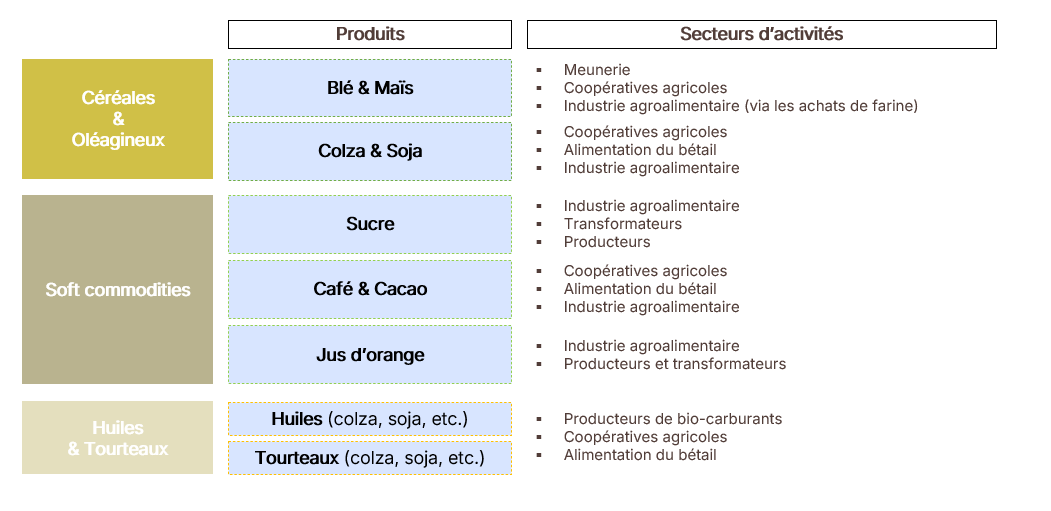
Wheat price crisis (durum and milling) in 2022
Same reason, with the Black Sea region accounting for 25 to 30% of global exports.
Cocoa crisis in 2024
The increase stemmed from a severe supply shock in West Africa, particularly in Côte d'Ivoire and Ghana: poor weather conditions, cocoa tree diseases, low harvests, smuggling, and sectoral dysfunctions on the Ghanaian side. These two countries account for approximately 50% of global supply. Prices rose from around $2,500/tonne to over $11,000/tonne during the crisis, subsequently reaching a record high of $12,931/tonne in December 2024. Prices remained elevated for 12 to 15 months.
Oil price crisis in 2026
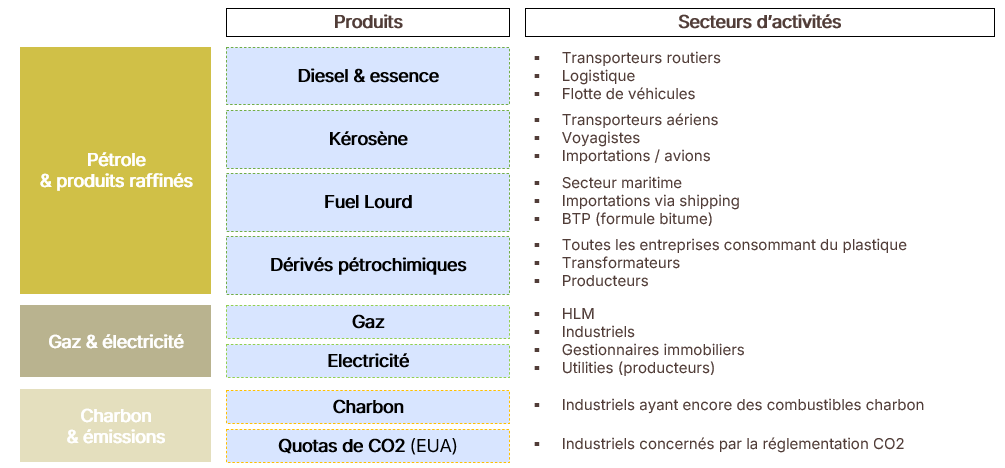
Following the escalation of tensions in the Middle East, putting pressure on production and also on the supply chain. The barrel price rose from $60 to $100 in a few days (Brent reference), with a similar impact on all refined petroleum products (Kerosene, Diesel, Gasoline, petrochemical derivatives, plastics, etc.).
WHICH RAW MATERIALS ARE WE TALKING ABOUT?
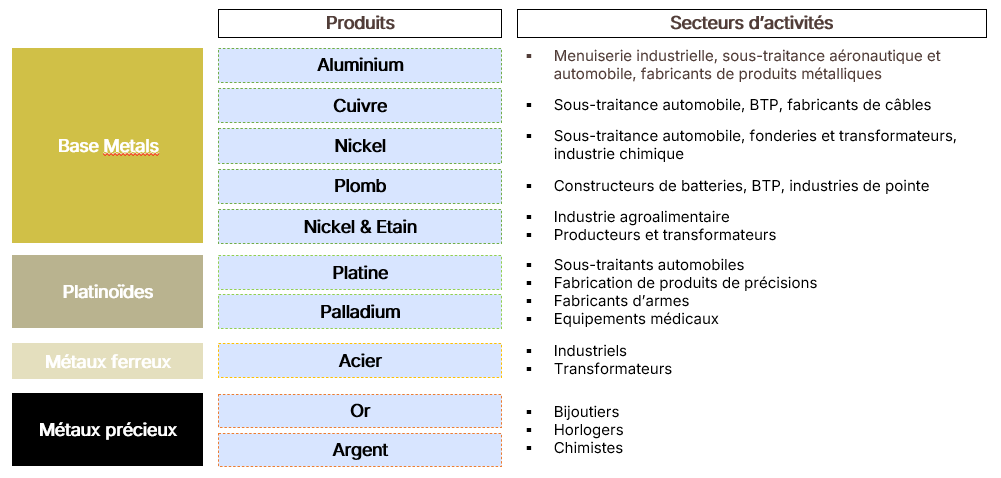
The major categories of raw materials
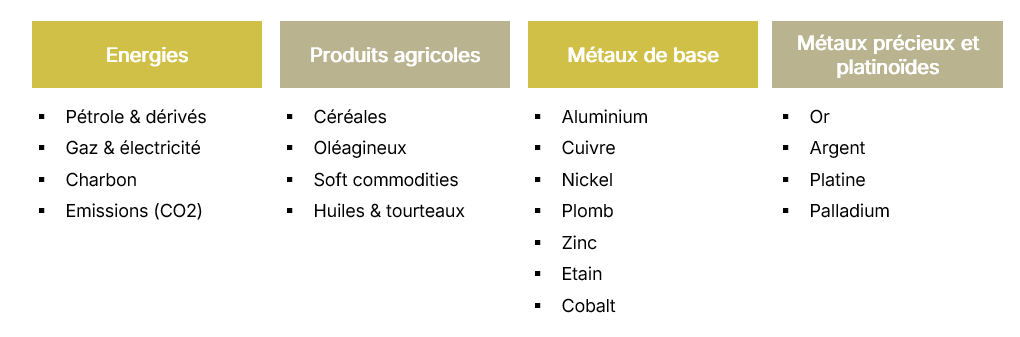
- Energy
- Agricultural Products
- Metals
The price of a raw material is tracked through a market benchmark published by an exchange or a market data provider.
Why is this important?
Because a financial hedge is not built on an "estimated price" or market perception. It is built on an objective, recognized, and published benchmark, in line with the methodology used by your suppliers for invoicing or contracting.
IMPACTS ON BUSINESSES
The impact of raw materials on a company does not solely depend on the absolute price level. It primarily depends on three very concrete variables: the proportion of inputs in the cost of goods sold, the company's margin level, and how its business model allocates risk between purchases and sales.
- The more a raw material weighs on the cost of goods sold, the higher the exposure.
The first factor is straightforward: the more a raw material represents a significant portion of the total production cost or cost of goods sold, the more sensitive the company is to its price fluctuations. This is evident in sectors where the main input shapes the economic model: transport and logistics with fuel, agri-food with cereals, oils, or sugars, and industry with steel, aluminum, or certain chemical components. In these cases, if a raw material accounts for 40% of a product's cost of goods sold, a 10% increase in that material does not have a negligible effect: it mechanically increases the total cost by approximately 4%, even before considering transport, energy, exchange rates, or labor. For a company operating with already negotiated selling prices, this shift can be enough to destabilize the profitability of a product range, a contract, or a fiscal year.
- The lower the margins, the more strategic volatility becomes.
A company with high margins can absorb increases in its inputs without jeopardizing its economic balance. Conversely, a company with low margins requires a highly strategic management of price variations.
Indeed, the narrower the margin, the more a cost variation can consume a significant portion of the profit. A company with an 8% margin is more significantly affected than another by a rise in raw material costs. If this deteriorates the cost price by 3 to 4 points, the profitability of the first disappears, while the second remains more resilient. For CFOs and executives, risk must be managed based on the combination of cost sensitivity and margin level, not solely on company size.
- The business model determines the true level of risk
Beyond the impact of materials and the margin level, the decisive factor is often the company's business model. This is where the true understanding of risk lies.
Case 1: Inputs fluctuate, but selling prices are fixed
This is the most sensitive situation.

The company purchases its raw materials at variable prices, determined by current market conditions, while its selling prices are set in advance for several months, or even several years. In this scenario, any increase in inputs potentially translates into margin compression.
This is the case, for example:
- for a company that sets its prices in October N for the entire year N+1;
- for a manufacturer responding to a call for tenders with a fixed price for 12 months;
- for an automotive subcontractor bound by a four-year contract with a manufacturer, with predetermined selling prices for the entire program duration.
In this type of model, the company bears a significant risk. It is subject to the volatility of its purchases without being able to quickly adjust its selling prices. If diesel, steel, aluminum, cereals, or exchange rates move unfavorably, the impact is directly on the margin. The longer the contractual horizons, the higher the risk, and the greater the need for contractual, commercial, or financial hedging.
Case 2: Inputs fluctuate, and selling prices also fluctuate
The situation is more favorable, but it does not eliminate the risk entirely.

Some companies have the ability to pass on both increases and decreases to their customers. They then sell based on current market conditions, sometimes with an indexing formula, sometimes with regular price adjustments. In this case, the risk associated with raw materials is indeed lower, as the increase in purchase costs can be passed on, fully or partially, to the end customer. However, this protection is only real if the economic cycle is short. As long as the purchased material is processed and then resold quickly, the company remains relatively aligned with the market.
However, the risk reappears as soon as there is a significant time lag between the purchase of the material and the sale of the finished product.
Consider a company that purchases its raw material on day 1 at current market conditions, then only processes and resells this material three to six months later, based on the market conditions observed at that time. If prices have fallen in the interim, it finds itself selling into a lower market a material that was purchased at a higher price. Its risk is therefore no longer just a risk of price increases; it's also an inventory risk and a price lag risk over time.
Raw material price fluctuations generally impact three dimensions simultaneously.
- First, they affect the cost price and thus the competitiveness of the offering.
- Next, the margin, especially when sales prices are rigid or renegotiated belatedly.
- Finally, visibility: the ability to build a reliable budget, commit to volumes, respond to a tender, or secure a minimum profitability.
The right question for a company to ask itself is therefore: “In our economic model, at what point and with what intensity does a price variation transform into a real financial risk?”
WHAT SOLUTIONS ARE AVAILABLE TO COMPANIES?
The first answer is that there is no single, perfect solution; on the contrary, building a risk management framework (financial, operational, compliance, environmental, etc.) is achieved through the implementation of a combination of commercial, contractual, operational, and financial levers.
- Negotiate fixed purchase prices with suppliers
This is often companies' first instinct: asking their suppliers for a fixed price over a given period to secure their purchasing budget.
- Incorporate re-indexing clauses into customer contracts
The second lever involves not acting on the purchase price, but on the ability to pass on an increase in contracts concluded with end customers.
Specifically, the company includes a clause stating that if the reference raw material increases beyond a certain threshold, for example +5%, +10%, or +15%, then the selling price can be adjusted, fully or partially. This is a particularly important lever for companies operating with tight margins and multi-month commercial contracts.
- Diversify suppliers to reduce supply risk and improve negotiating power
Supplier diversification is not, strictly speaking, a financial hedge against price risk. However, it is a major tool for reducing overall raw material-related risk.
Why? Because a company doesn't only suffer from price increases. It can also suffer from a lack of availability, logistical delays, a geopolitical incident, a quality defect, a force majeure event, or a sudden disruption in the supply chain. However, in certain situations, the real risk is no longer "paying more," but not being delivered at all.
- Implement financial hedging
Finally, there is the lever most directly linked to hedging: financial hedging. Its objective is not to optimize the purchase price in a commercial sense, but to reduce exposure to volatility by relying on a pre-defined market reference.
This is often the most strategic solution when a company wants to protect a budget, stabilize a cost price, or manage its margin over several months. However, it is also one of the most misunderstood, and often one of the least accessible for SMEs and mid-cap companies.
WHERE TO START FOR COMPANIES?
Our Keewe experts are here to help you explore this topic, guiding you step-by-step:
- Identification and quantification of your exposure to raw material risk
- Review of your supplier contracts to ensure the indexation formula used by your suppliers for various variables (raw materials, currencies, etc.)
- Development of a raw material risk hedging policy:
- Hedged volume
- Hedge maturity
- Hedging products
- Hedging currency
- Budget rate
- Etc.
For more information, here is the webinar replay on this topic
.png)
Pour aller plus loin, découvrez nos derniers articles.
Vous y trouverez les recommandations de nos experts pour gérer vos opérations de commerce international de façon plus durable et responsable.

.png)

.jpg)
.jpg)